
FREDERICK DOUGLASS: What Douglass Actually Believed (Part 2 of a 3-Part Series)
The 12 Life-Empowering Values. The Three CRT Assertions Answered. Issue by Issue, in His Own Words.

If you missed Part 1, start here. This series is better read in order. Find it at Frederick Douglass: The Weapon They Never Saw Coming (Part 1 of 3).
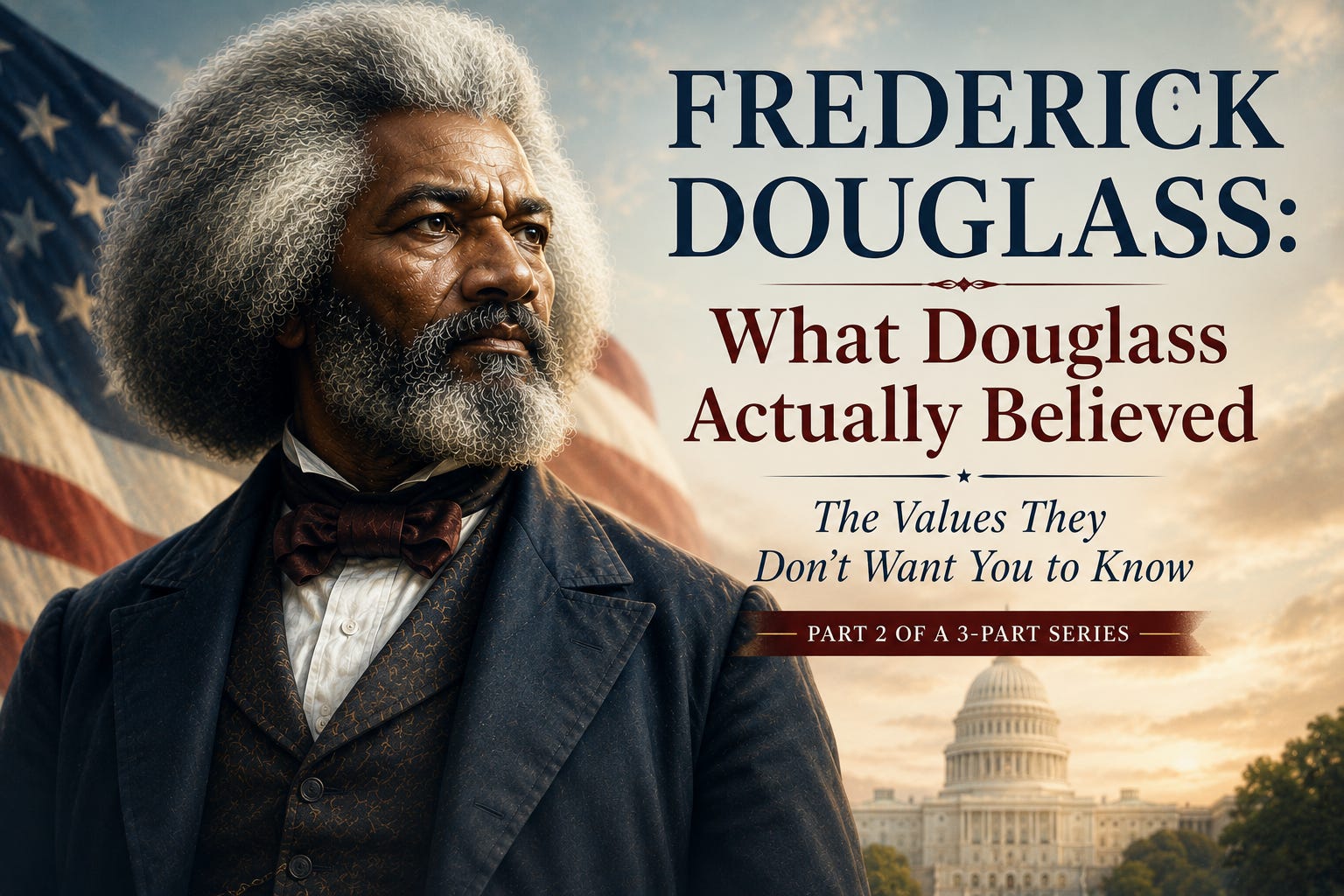
The left has worked hard to make sure you don’t know Frederick Douglass. Not the real one.
The Marxists have worked hard to make sure you don't know Frederick Douglass. Not the real one. They will occasionally mention him. They will quote him selectively. But they will never tell you what he actually believed, because what he actually believed destroys every argument they have ever made.
He believed in God-given rights. Personal responsibility. Limited government. Free speech. School choice. The right to keep and bear arms. The Constitution as a document of liberation, not oppression.
He believed that your identity comes from your Creator, not your racial group.
He believed that the way out of poverty is WORK, not dependence.
And he wrote about all of it, in his own words, from the perspective of a man who had been denied every one of those rights for the first twenty years of his life.
Everything in this article flows from a framework developed by my friend KCarl Smith, a retired U.S. Army officer, best-selling author, and creator of the Frederick Douglass Messaging Strategy.
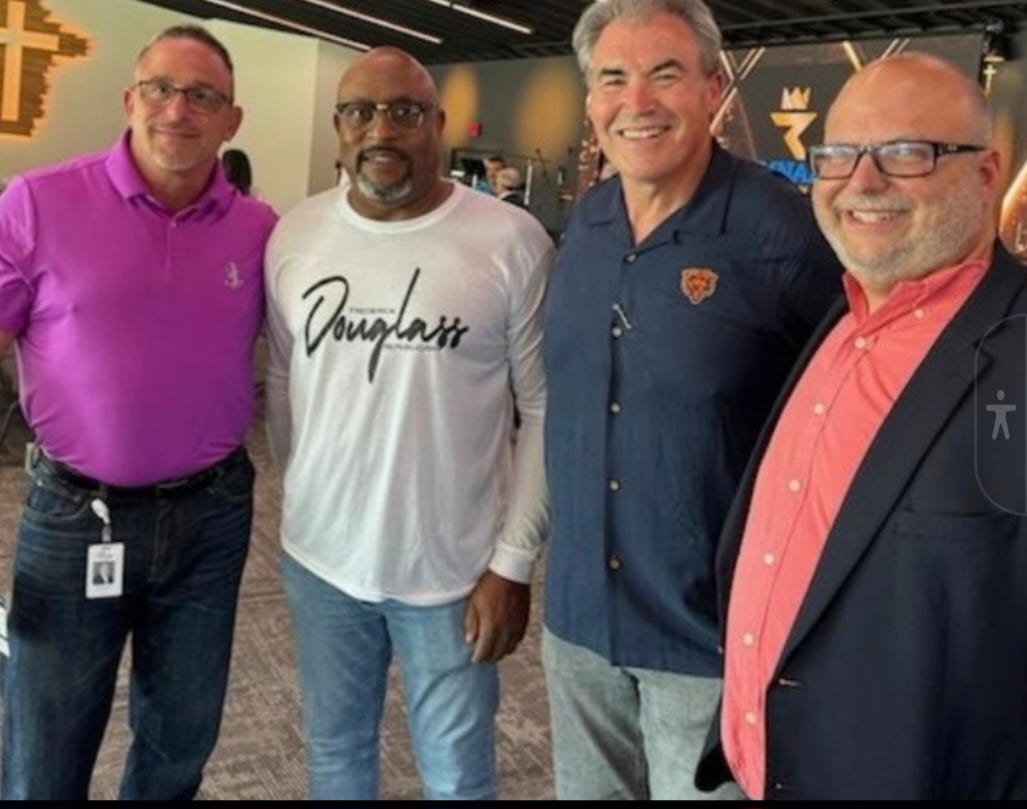
KCarl has spent over a decade studying Douglass’s documented writings and building a practical engagement model that pastors, citizens, and civic leaders can use in real conversations. All credit for the framework, the 12 Life-Empowering Values, and the CRT response strategy belongs to him. His book Douglass vs. Marx: The Battle for America’s Soul is the most comprehensive version of this work available anywhere. Find it at kcarl.company.site. What follows is his framework, presented here because it deserves to be heard.
If someone shared this article with you and you are not yet subscribed, do it now. Part 3 drops Monday July 14th and it is the one that brings the whole series home. Subscribe below. It is free.
The 12 Life-Empowering Values of Frederick Douglass
KCarl has identified 12 Life-Empowering Values drawn directly from Douglass’s writings and life. Read this list carefully. Every single one of these values is under assault today. And Frederick Douglass wrote about every single one of them.
Respect for the U.S. Constitution
Respect for Life
Belief in the Limited Power of Government
Belief in Personal Responsibility
Economic Prosperity
Education and Parental Choice
Women’s Rights
The Right to Keep and Bear Arms
Free Speech
Religious Liberty
Immigration
The Right to Vote

Every single value on that list aligns with a biblical worldview. Every single one is being attacked today. And you cannot call Frederick Douglass a racist for holding them. He was a victim of racism who refused to stay a victim. That is exactly why, as KCarl says, those who promote a Marxist worldview do not want you to know him.
“Knowledge makes a man unfit to be a slave.” — Frederick Douglass
If you know a pastor, a parent, a school board member, or a civic leader who needs to see this list, share this article right now. These are not partisan talking points. These are the documented values of a man who survived slavery and built a $11.6 million legacy. They belong to every American.
Douglass Answers Critical Race Theory
Here is what makes KCarl’s framework so powerful. He takes the three core assertions of Critical Race Theory, which stems from Critical Theory, and answers each one directly with Frederick Douglass’s own words. Not talking points. Not political arguments. Douglass’s actual documented words. This is KCarl’s framework, presented here in his honor.
CRT Assertion #1: Black people are perpetual helpless victims of White racism.
Douglass answers this directly and completely:
“Do nothing with us, by us, or for us as a particular class. The broadest and bitterest of the black man’s misfortune is the fact that he is everywhere regarded and treated as an exception to the principles and maxims which applied to other men.” — Frederick Douglass
“What I ask for the Negro is not benevolence, not pity, not sympathy, but simply justice. Do nothing with us! Your doing with us has already played the mischief with us. If the Negro cannot stand on his own legs, let him fall also. All I ask is, give him a chance to stand on his own legs! Just let him alone! Your interference is doing him a positive injury.” — Frederick Douglass
There is no victim narrative in Frederick Douglass. None. He demanded justice, not pity. He demanded opportunity, not outcomes. He demanded to be left alone to stand or fall on his own. That is the complete opposite of what CRT teaches.
CRT Assertion #2: White people are innately racist, with absolutely no redeeming qualities.
Douglass answers this with his own life. His former slave master Thomas Auld eventually freed his slaves and took Douglass’s elderly grandmother into his own home to care for her. Douglass wrote to him:
“I have been told that you have ceased to be a slaveholder, and that you have taken my poor old grandmother from the desolate hut in which she formerly lived, into your own kitchen, and are providing for her in a manner becoming a man and a Christian. This, Sir, is good news.” — Frederick Douglass
In 1877, the two men met face to face. Auld said: “Frederick, I always knew you were too smart to be a slave.” Douglass replied: “I did not run away from you. I ran away from slavery.”
A man who had been beaten and enslaved chose grace over grievance when grace was warranted. That is not CRT. That is the Gospel.
CRT Assertion #3: There are no absolutes.
This is the most important assertion of all, because it is the foundation of everything else. No absolutes means no God, no fixed truth, no moral standard. Douglass understood exactly what that leads to:
“The first work of slavery is to mar and deface those characteristics of its victim which distinguish men from things, and persons from property. Its first aim is to destroy all sense of high moral and religious responsibility. It reduces man to a mere machine. It cuts him off from his Maker, it hides him from the laws of God, and leaves him to grope his way from time to eternity in the dark, under the arbitrary and despotic control of frail, depraved, and sinful fellowmen.” — Frederick Douglass
Slavery’s first weapon was the destruction of moral and religious absolutes. CRT uses the same weapon today. Douglass named it 150 years before anyone called it Critical Race Theory.
What Douglass Believed, Issue by Issue
On the Constitution
“The Constitution reads, ‘We the People,’ not ‘We the white people.’ And if Negroes are people, they are included in the benefits for which the Constitution of America was ordained and established.” — Frederick Douglass
“The problem is not with the Constitution. The problem is in the application of the Constitution. The problem is not with the Bible. The problem is in the application of the Bible.” — Frederick Douglass
On Education and School Choice
When Douglass tried to enroll his nine-year-old daughter Rosetta in one of the best private schools in Rochester, she was expelled because of her skin color. He did not accept it quietly:
“I am glad to inform you that you have not succeeded as you had hoped to do, depriving my child of the means of a decent education. She had not been excluded from Seward Seminary five hours before she was gladly welcomed into another respectable and equally Christian school. She now sits in a school among children as pure and as white as yours, and no one is offended. Now I should like to know how much better you are than me and how much better your children are than mine.” — Frederick Douglass
He then turned that personal fight into a public campaign and desegregated the Rochester school system. A man born into slavery fought for school choice in the 1840s. The same forces that denied Rosetta a quality education are fighting school choice today.
On Personal Responsibility and Government
“If you see him plowing in the open field, leveling the forest, at work with a spade, a hoe, a pickaxe, or a bill, let him alone. He has the right to work. If you see him on his way to school with a spelling book, geography, or arithmetic in his hands, let him alone. Don’t shut the door in his face or bolt your gates against him. He has a right to learn. Let him alone.” — Frederick Douglass
On the Right to Keep and Bear Arms
“A man’s rights rest in three boxes: the ballot box, the jury box, and the cartridge box.” — Frederick Douglass
On Free Speech
“Liberty is meaningless where the right to utter one’s thoughts and opinions has ceased to exist. That, of all rights, is the dread of tyrants. It is the right which they first of all strike down.” — Frederick Douglass
On God, Truth, and Identity
“Right is of no Sex. Truth is of no Color. God is the Father of us all, and we are all Brethren.” — Frederick Douglass
“One and God make a majority.” — Frederick Douglass
More Douglass Worth Knowing
These did not fit neatly above but they are too good to leave out. Screenshot them. Share them. Use them.
“No people to whom liberty is given can hold it as firmly and wear it as grandly as those who wrench their liberty from the iron hand of the tyrant.” — Frederick Douglass
“Find out just what any people will quietly submit to and you have the exact measure of injustice and wrong which will be imposed on them.” — Frederick Douglass
“It is easier to build strong children than to repair broken men.” — Frederick Douglass
“To deny education to any people is one of the greatest crimes against human nature.” — Frederick Douglass
“Some know the value of education by having it. I know its value by not having it.” — Frederick Douglass
“Freedom is a road seldom traveled by the multitude.” — Frederick Douglass
“The life of a nation is secure only while the nation is honest, truthful, and virtuous.” — Frederick Douglass
“I remember that God reigns in eternity, and that whatever delays, whatever disappointments and discouragements may come, truth, justice, liberty and humanity will ultimately prevail.” — Frederick Douglass
The Framework That Changes Every Conversation
You cannot call Frederick Douglass a racist. You cannot dismiss him as a tool of white supremacy. He was enslaved, beaten, and denied his rights, and he still believed in the Constitution, in God-given liberty, in personal responsibility, and in the founding promise of this nation.
His life is the complete refutation of every argument Marxism makes. And KCarl Smith has spent over a decade making sure that refutation is available to every pastor, every citizen, and every parent who needs it. I am grateful for his work. I am grateful he walked into that little theater in Mulberry in February 2022. It changed everything about the way I engage in civic conversations.
If you have not yet watched the conversation between KCarl Smith and Citizens Defending Freedom CEO Colby Wiltse on The Defending Freedom Show, do it this week. KCarl expands on everything in this series including the Douglass framework, Marxism, DEI, and what the Church needs to do right now. Watch it here. Share it when you are done.
And get the book. Douglass vs. Marx: The Battle for America’s Soul by KCarl Smith is thirty-one head-to-head debates drawn entirely from the documented writings of both men. It is a curriculum for churches, families, schools, and civic groups. Every argument sourced. Every word real. Find it at kcarl.company.site.

Part 3: Frederick Douglass: The History They Never Taught You drops Monday July 14th. It covers the history both parties don’t want you to see, the System Swap that turned Marxism into CRT and DEI, and the closing argument that brings this entire series home. You will not want to miss it.
Subscribe below if you haven’t already. And if this article served you, share it. Send it to a pastor. Forward it to a city commissioner. Text it to a friend who is exhausted by the left-right battle. Post it somewhere someone unexpected might see it. Frederick Douglass has been waiting 130 years for this moment. He changes conversations. Let him start one today.